Build Your Own Sound Effects Kit
Ten effects you can keep and reuse, each with the prompt that made it.
You can make your own sound effects with AI by describing each sound in one line: what it is, how long it lasts, and where it goes in the edit. In MITO, use ElevenLabs v3 for short sounds up to 30 seconds and Mirelo SFX 2.0 for longer ones. Generate three takes of each, keep the best, and reuse the same set in every video.
Most editors cut with the same handful of sounds: a riser before the reveal, a whoosh on the cut, a hit on the title, a pop when text appears. Usually they come from a pack everyone else is using too, so your videos sound like everyone else’s.
A kit you make yourself sounds like you. Below are the prompts for two kits, one for creators and one for a small business, plus what each sound costs and how to put the kit together.
The creator kit
These four cover most short-form edits. Each prompt follows the same pattern: say what it is, how long, and where it goes in the edit.
Riser: “Rising synth swell, 3 seconds, builds tension and stops dead, for the moment before a reveal.”
Whoosh: “Fast air whoosh moving left to right, 1 second, for a quick cut.”
Hit: “Deep cinematic impact with a short tail, 2 seconds, for a title card.”
Pop: “Soft bubble pop, half a second, for text appearing on screen.”
The last part of each prompt matters more than it looks. “For the moment before a reveal” tells the model the riser has to build and then stop, not fade out. “For a quick cut” keeps the whoosh short and sharp. “For text appearing on screen” keeps the pop soft enough to sit under a voiceover.
The direction is worth writing too. “Moving left to right” gives the whoosh a pan you can match to a slide transition in the same direction.
The brand kit
People know big brands by a sound as much as by a logo. The same few notes at the end of every ad do a lot of the work.
You can build that for a small business the same way. Make a short sound logo (a few notes that play at the end of every video you post), a signature transition, and the sounds of your product and your space. Then use the same ones in every video, so your content sounds like you.
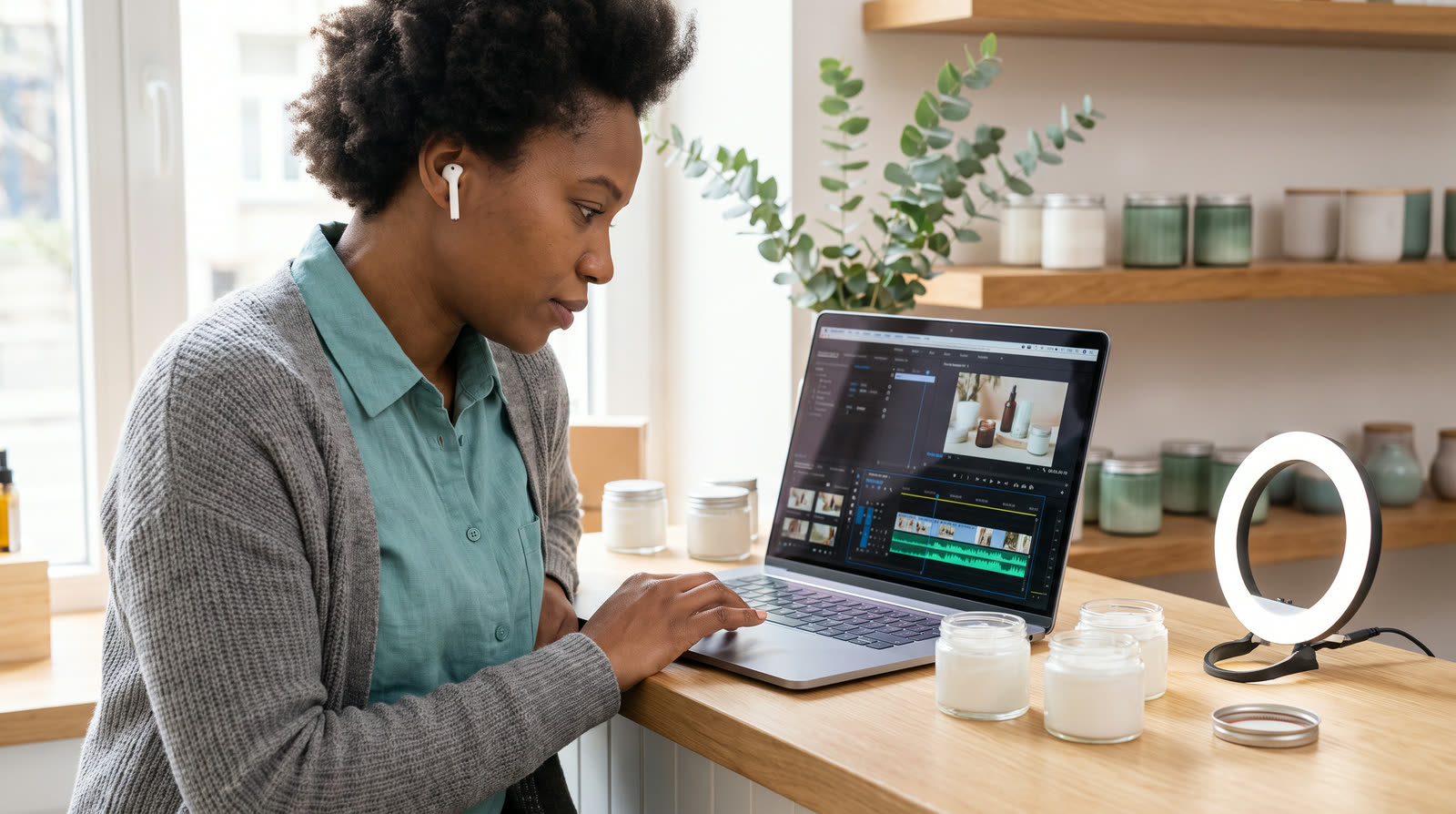
The brand kit goes at the end and on the cuts of every product video.
Sound logo: “Three bright, warm chime notes, 3 seconds, clean and friendly, for the end of a brand video.”
Signature transition: “Soft whoosh with a light shimmer, 1 second, for cuts between products.”
Your product: “A glass jar lid unscrewing, close up, quiet room.”
Your space: “A small shop in the morning: door chime, quiet chatter, no music.”
The product and space sounds are where a kit stops sounding generic. Swap in what your customers actually hear: the lid on your jar, the grinder in your café, the bell on your door. “Quiet room” and “no music” keep the take clean, so you can lay it under anything.
Ten sounds worth having
Watch a few dozen viral TikToks, Reels or Shorts with the sound on and the same ten effects keep coming back: the boom on the reveal, the record scratch before the flashback, the crickets after a joke that didn’t land. We made all ten in MITO with ElevenLabs v3. Play them here or download the MP3.
Our first try at these sounded generic. We’d just named them, “a riser” and “a whoosh”, and that’s what we got: a riser, but not the riser. For sounds people already know by ear, a short line isn’t enough. What fixed it was describing the sound itself instead of naming it: how it starts, which way the pitch moves, how long the tail rings and what kind of room it’s in. Here are the prompts behind the ten above:
- Meme boom: “One single enormous low boom, like a giant bass drum struck once inside a vast empty concrete hall. Instant hard attack, a deep sub-bass punch around 40 Hz that hits the chest, slightly saturated, then a long dark booming reverb tail that rolls and decays slowly to silence over two seconds. One hit only, no music, no melody, no other sounds. Very loud, heavy, dramatic.”
- Riser: “Electronic tension riser before a drop: a white noise sweep plus a synth tone rising continuously in pitch and volume over three seconds, the filter opening so it gets brighter and brighter, a pulsing tremolo that speeds up as it climbs, building to a peak and then cutting off instantly into silence. No drums, no tail at the end, isolated.”
- Whoosh: “Fast clean air whoosh transition: a quick swoosh of air passing very close to the microphone from left to right, rising then dropping in pitch like a doppler fly-by, bright airy hiss, soft start, peak in the middle, short tail. Under one second, isolated, no music.”
- Record scratch: “A single vinyl record scratch: the needle drags backward across a spinning record, a quick rough zip of scratchy vinyl friction with the pitch diving down as the turntable is stopped by hand, ending in sudden silence. One scratch only, about one second, dry, isolated, no music.”
- Dramatic sting: “Dramatic orchestral sting: brass and low strings play three loud notes descending in a minor key, dun, dun, duuun. The first two are short and punchy, the third is lower and held, swelling with a timpani roll and trembling string tremolo, then ringing out with concert hall reverb. Melodramatic suspense, about three seconds, nothing else.”
- Crickets: “A single cricket chirping slowly in total silence, close and clear, a rhythmic chirp, chirp, chirp with pauses between, quiet still night, nothing else.”
- Ka-ching: “Old mechanical cash register ka-ching: a quick metallic clunk of the cash drawer springing open and slamming, immediately followed by a bright, clear, high bell ding that rings out with a short shimmer. Crisp and cheerful, about one and a half seconds, isolated.”
- Wrong buzzer: “Game show wrong-answer buzzer: a harsh, loud, low, flat electric buzz with a rough square-wave tone around 100 Hz, constant pitch, starting instantly and stopping abruptly after one second. No reverb, no music, no voices, isolated.”
- Sad trombone: “Sad trombone, wah wah wah waaah: a solo trombone with a plunger mute plays four descending notes, each a half step lower, the first three short and the last one long, sagging and wobbling with a wide slow vibrato as it fades out. Comedic failure sound, dry, about three seconds, no other instruments.”
- Cartoon boing: “Cartoon spring boing: a twangy metal spring is plucked and bounces, a springy boyoyoyoing that wobbles rapidly and slides down in pitch, bright jaw-harp-like twang, fading out in about one second. Isolated, no music.”
We made three takes of each and kept the one closest to the sound people know. Takes vary a lot. One of our booms came back as a long ringing note instead of a hit, and two of the three stings had the wrong number of notes.
Before saving, we cut the silence off both ends of each file, added a short fade (except on the riser and the scratch, which need to stop dead), and set all ten to the same loudness, so none of them jumps out when you swap one for another.
Which model to use
MITO runs two sound effect models, and the choice comes down to length. Short sounds go to ElevenLabs v3. Room tone, the quiet background sound of a space with nobody talking, and other long ambience go to Mirelo SFX 2.0.
| Model | Length | Best for |
|---|---|---|
| ElevenLabs v3 | Up to 30 s | Risers, hits, pops, logos |
| Mirelo SFX 2.0 | Up to 10 min | Room tone, ambience |
Every sound above is short enough for ElevenLabs v3. The shop ambience is the one to think about: if you want it running under a full 60-second video instead of looping a short clip, make it with Mirelo SFX 2.0.
What a kit costs
ElevenLabs v3 charges 9 credits per second of sound, rounded up to the whole second. A 1-second whoosh is 9 credits. Our 1.5-second ka-ching cost 18, the same as 2 seconds.
That makes the creator kit cheap to make properly:
- Riser, 3 seconds: 27 credits a take
- Whoosh, 1 second: 9 credits a take
- Hit, 2 seconds: 18 credits a take
- Pop, half a second: 9 credits a take, the shortest sound it makes
That’s 63 credits for one take of each. Three takes of each is under 190 credits, and you only pay it once. That’s the point of a kit: the cost is spread over every video you put it in.
Because you pay by the second, set the length to what the edit needs. A 1-second whoosh costs half as much as a 2-second one, so don’t ask for more than the cut uses. Stick to whole seconds, since 1.5 costs the same as 2.
The ten sounds in this post cost 207 credits for one take of each, and just over 600 for three takes of all ten.
Picking the best take
Generate three takes of every sound, then judge them in context, not on their own:
- Put it on the cut. Drop each take under the edit it’s meant for. A hit that sounds big on its own can swamp a voiceover.
- Check the ending. The riser should stop dead, not trail off. The hit should have a short tail, not a long echo.
- Listen on a phone. Most of your audience will. Deep impacts lose a lot on a phone speaker, so pick the take that still lands there.
- Play the sound logo five times in a row. If it gets annoying, it will get annoying at the end of every ad. Pick the one you can live with.
If none of the three works, change one thing in the prompt (“shorter tail”, “less shimmer”, “lower pitch”) and generate again, instead of rewriting the whole line.
Keep the kit together
Keep every sound in one project, named “Sound kit” or “Brand sounds”, so you always know where the current version is. When you start a new video, download the sounds you need and drop them into the edit.
Give the files names that say where they go: riser-reveal-3s, whoosh-cut-1s, hit-title-2s, pop-text-0.5s. Six months from now you’ll know which one goes before the reveal without playing all of them.
If you want the full picture of sound in a video, from voiceover to music to effects, How to Add AI Voice and Sound to Video covers the rest. For music beds, see Best AI Music Generator for Video, and for building a whole scene’s soundtrack, Sound Design for AI Film.
Try it
- Start a project called “Sound kit” (or “Brand sounds” for a business).
- Generate a riser, a whoosh, a hit and a pop with ElevenLabs v3, three takes each. For a brand kit, start with a sound logo and a transition.
- Keep the best take of each and name the files by where they go.
- Download them and drop them into your next edit. For a brand kit, the sound logo goes at the end and the transition on the cuts.
Frequently asked
- Can AI make sound effects for video?
Yes. In MITO you describe the sound in one line, including how long it should be and where it goes in the edit, and a sound effect model generates it. ElevenLabs v3 makes sounds from half a second up to 30 seconds, and Mirelo SFX 2.0 makes sounds up to 10 minutes long.
- How do I write a prompt for a sound effect?
Say what the sound is, how long it lasts and where it goes in the edit. For example: “Fast air whoosh moving left to right, 1 second, for a quick cut.” The length controls the cost and the timing, and the “where it goes” part tells the model how the sound should start and end.
- How much does an AI sound effect cost in MITO?
ElevenLabs v3 costs 9 credits per second of sound, rounded up to the whole second, so a 2-second hit is 18 credits. A full creator kit of a riser, a whoosh, a hit and a pop, with three takes of each, comes to under 190 credits.
- What's the difference between ElevenLabs v3 and Mirelo SFX 2.0?
Length. ElevenLabs v3 is for short sounds from 0.5 to 30 seconds, like whooshes, hits and sound logos. Mirelo SFX 2.0 goes up to 10 minutes, so use it for room tone or ambience that runs under a whole scene.
- What is a sound logo?
A sound logo is a short, recognizable sound, usually two to four notes, that plays at the end of every video a brand makes. Over time people link the sound to the brand, the same way they link a visual logo. A good one is about 3 seconds long.
- How many takes should I generate for each sound?
Three is a good number. Generate three, test each one under the cut it’s meant for, and keep the best. If none work, change one word in the prompt and try again.
The AI tool for cinematic video.
Generate, direct, and publish professional videos, powered by the best AI models.